


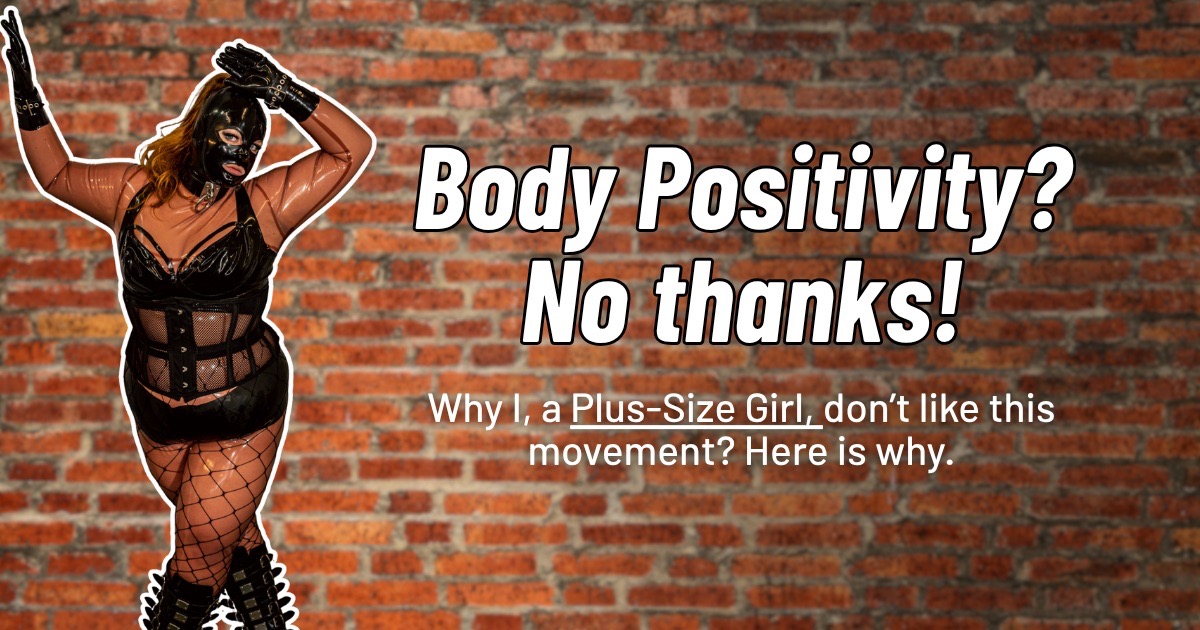
I’ve been thinking about Body Positivity a lot lately. Not because I think the people behind it have bad intentions. But because I genuinely believe it broke the thing it was trying to fix. And nobody seems to want to say that out loud, because it sounds like an attack on something that was supposed to be good.
So let me say it anyway.
Where Body Positivity Actually Came From
Body Positivity didn’t start with Dove campaigns. It started in the 1970s with fat activists fighting for something concrete: the right to exist in a fat body without being discriminated against in healthcare, at work, in public spaces. That was a political movement. It had actual stakes. It was about dignity, not aesthetics.
Then beauty brands discovered it.
And suddenly Body Positivity meant feel-good Instagram posts and campaigns with women of varying sizes all smiling into cameras and a collective agreement that all bodies are beautiful. Which sounds lovely. Except nothing about the underlying premise changed.
The rule is still: your body needs to be beautiful. We just expanded the guest list.
The New Impossible Standard
And then came the part that really gets me. The expectation that you feel good about your body at all times.
That you look in the mirror and find something to celebrate. That on your worst days — the bloated, exhausted, couldn’t-sleep-properly ones where you genuinely just aren’t feeling it — you somehow still manage to love what you see. And if you don’t? You’ve failed. Again. Just with a different scoreboard.
I know those days. I still have them. My body stores most of its fat at my belly and hips, and there are mornings where I pull on an outfit and nothing about it feels right. When I say that out loud, people get uncomfortable. Like I’ve failed some test. Like I, of all people, should have sorted this out by now.
But why do I have to pass that test?
Body Positivity in its current, marketable, mainstream form swapped one impossible standard for another. First it was: be thin, be toned, be symmetrical. Now it’s: feel joyful about your body. Always. Enthusiastically. Without exception. One way to fail replaced another. The cage got a fresh coat of paint. But it’s still a cage.
What a Kink Event Taught Me That Instagram Couldn’t
There’s a specific memory I come back to sometimes. I was at a kink event. Latex, a crowded room, people in all kinds of bodies doing all kinds of things. And I noticed something that I couldn’t have articulated at the time but that I’ve thought about a lot since: nobody in that room was checking whether their belly looked right from a certain angle. People were in their bodies — feeling things, experiencing things, fully present in a way that had nothing to do with aesthetics.
I was wearing a latex dress I’d hunted down for weeks because finding pieces that fit my proportions took real effort. (Size availability in latex is a whole conversation we can have another day.) But once I had it on, I wasn’t thinking about how I looked. I was thinking about how I felt. And for someone who’d spent years treating her body as a before-photo, that was genuinely new.
Body Positivity never gave me that. Being told I was beautiful never gave me that. What shifted it was a space where beauty wasn’t the point. Where bodies existed to do things and feel things and be present — not to be evaluated.
I’m not saying kink events are the path to self-acceptance for everyone. Obviously not. But the underlying principle is something I’ve tried to carry into everyday life.
What if my body isn’t a problem to be solved? What if it’s just... the vehicle I live in?
What Body Acceptance Actually Is
What I believe in is called Body Acceptance. Or Body Neutrality, depending on who you ask — the terms get used interchangeably, but the core idea is the same.
It doesn’t ask you to find your body beautiful. It doesn’t ask you to feel anything specific. It simply says: this is your body. It exists. It carries you through your days. That’s enough.
My worth isn’t measured by how I look on a random Tuesday afternoon. It isn’t measured by whether I’ve hit some emotional benchmark of compulsory self-love. It just isn’t measured by that.
Here’s what actually helps me on the hard days — not the “love yourself” reminders, but this:
- Remembering that my body is not a problem to be solved
- Noticing what my body can do rather than how it appears
- Letting a bad body image day just be a bad body image day — not a referendum on my worth
- Not performing positivity I don’t actually feel
That last one matters more than it sounds. We’ve been so conditioned to perform wellness, to show up happy and grateful and glowing. Body Acceptance says you don’t owe anyone that performance. You’re allowed to have a day where you look in the mirror and think “yeah, not my favourite view today” — and then go live your life anyway.
You Don’t Have to Love It. You Just Have to Let It Exist.
And here’s the thing people always want to add at this point: “But you can still WANT to change things, right?” Yes. Absolutely. Body Acceptance isn’t a rule that says you’re not allowed to want to move more, eat differently, or work on something about yourself. Of course you can.
But hate, pressure, and fear have never been good motivators. They create cycles of punishment, not change. The only foundation that actually works long-term — for anything — is care. You take care of something you value. You don’t beat it into shape.
Acceptance isn’t defeat. It’s not giving up on yourself or on growth. It’s refusing to stake your entire sense of worth on a daily emotional check-in with your reflection. It’s the starting point, not the finish line.
Do it on the days you feel good. Do it on the days you absolutely don’t. Do it anyways.
You won’t find “love the skin you’re in” content here. Not because I want anyone to feel bad — genuinely, truly, the opposite. But because I think you deserve more than a prettier cage. You deserve a door that actually opens.
I see you. I feel you. And you don’t have to pass any test today.